


Red Alert: Help Cattle Manage Heat Stress
No geographic region or livestock system is safe from the potential drawbacks of heat stress. In cattle, that can mean a drop in performance or worse. Even grazing systems can be at risk for losses — and heat pressure can continue through the fall.
Temperature fluctuations are critical
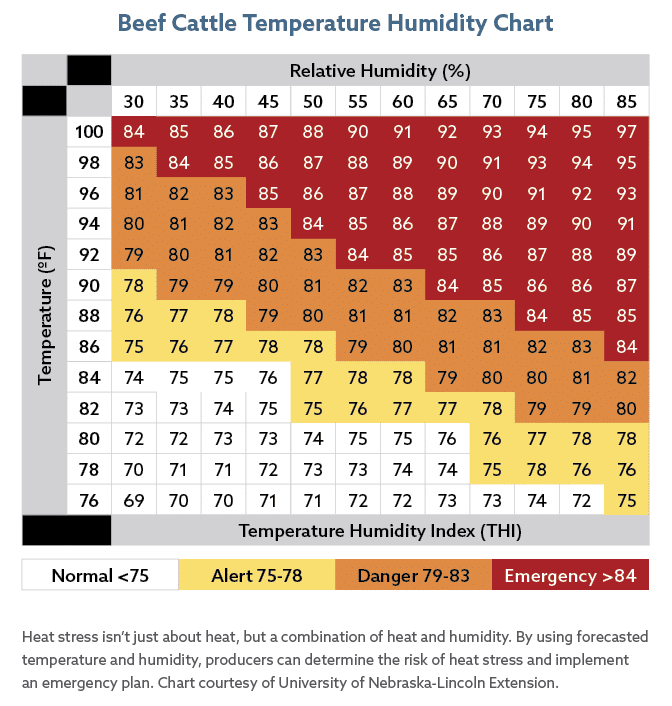
Temperature alone does not always cause stress. It occurs when both the temperature and humidity reach a point where the animal can no longer effectively dissipate the heat. This point can change for different age groups of cattle or stages of production.
“Heat waves and temperature extremes have become increasingly frequent over recent decades, and mean ambient temperatures continue to rise,” said Jongkyoo Kim, Ph.D., assistant professor of animal science at Michigan State University. “What has become increasingly apparent is that temperature fluctuation can be just as damaging as sustained high temperatures, and this is particularly relevant in the Midwest.”
Kim points to the loss of more than 2,000 feedlot cattle in 2022 after experiencing 30-degree temperature swings during a three-day period. He was part of a research team that demonstrated beef steers can experience severe physiological stress, with muscle responses comparable to those seen under extreme heat, at a THI as low as 70 — which corresponds to temperatures below 80°F — when preceded by large temperature fluctuations.
“Thermal variability, not just peak temperature, is a critical stressor for livestock,” Kim said.
Humidity counts, too
Even cattle in northern states can feel the effects of heat stress when humidity levels increase.
“Heat stress can happen any time you have high humidity and warm temperatures — especially when it doesn’t cool down at night,” said Kable Thurlow, beef and grazing educator at Michigan State University Extension. “If we get into the 90s here, that’s hot for us. A 90-degree day at 35 percent humidity puts you in the danger zone.”
Herd genetics can contribute to heat stress, too. Black-hided cattle are more susceptible to heat stress even compared to red-hided cattle. Research has shown that cattle with dark hides had a 2°F higher core body temperature.1
Pulling back performance
Once the heat stress threshold is passed, producers should consider pausing activities that would generate additional heat, like processing or moving cattle. The peak daytime temperature is not the only factor. The nighttime temperature must be considered as well.
“If cattle have to be worked, do it in the early morning hours when it’s cooler,” Thurlow recommended. “That’s better than evenings. Even though the temperature might be cooler in evenings, cattle haven’t had that period to cool off as they do overnight.”
Heat stress can lower reproductive performance, potentially affecting both female and male cattle.
“The goal of a cow-calf operation should be to have a calf every year,” Thurlow said. “Heat stress can cause embryonic death loss, and mess with bull fertility. Some research even shows high temperature systems can drop semen quality for several weeks following the weather event.”
In addition to reproductive losses, feed consumption often drops during heat stress. That can mean a drop in performance for any livestock system.
Provide stress relief
Even in grazing systems, producers can take steps to reduce the effects of heat stress on cattle, including:
- Maintaining adequate water intake
- Shielding above-ground water lines from direct sunlight
- Providing shade with portable structures or buildings, which can reduce heat load by up to 10°F
- Ensuring accessible buildings are well ventilated
- Moving cattle to fields with shade trees
“In a pasture situation, I recommend producers reserve more shaded pastures for July through August and even into September. It seems like the past few years, that has been one of the warmer months than in the past,” Thurlow said.
In recent years, Thurlow recommended implementing silvopasture techniques, which is an agroforestry practice that intentionally integrates trees, forage and livestock on the same land.
“This practice is way more than just a wooded pasture. It’s an intensively managed system where the livestock are only in one spot for a short period of time, allowing for recovery of forages and sustaining trees.”
Access to clean feed and water is one of the most important ways to combat heat stress. Like humans, cattle require water to regulate their temperature and replenish moisture lost through sweating and panting. Ambient temperatures in the mid-90s can increase cattle water requirements by 2.5 times compared to 70°F.1
Water tanks in pastures can create mud in the surrounding areas if the tanks aren’t moved or reinforced with concrete slabs or wood chips. Free access to streams or ponds can be a good water source, but producers must maintain water quality by moving cattle to different parts of the waterway at regular intervals.
Get ahead of heat stress
Producers and veterinarians alike should be aware of potential heat stress periods and begin to observe cattle and make adjustments to prevent losses.
“Any operation — beef cattle, stocker cattle, grazing cattle, feedlot operations, sheep farms, goat farms or poultry — they could all have issues with heat stress,” Thurlow said. “I’d recommend even hanging a THI chart on the shop wall to remind producers of the importance.”
- Environmental conditions that contribute to heat stress include minimal cloud cover, little to no air movement, high relative humidity, and high overnight low temperatures (above 70°F).1
- Early symptoms of heat stress include increased standing behavior, shade seeking, faster breathing rates or panting, increased water intake and bunching around water sources.2
- Open-mouthed panting, stringy drool, foam or tongues sticking out indicates more severe heat stress.2
- Water intake is critical before, during and after periods of stress.2
- Periods of heat stress can cause a drop in production that lags one or two days following the event.2
- Production drops are caused by decreased feed intake, which causes slower growth rates, lowers milk yields and can reduce fertility.
Photo Credits:
istockphoto.com/Timothy Vining
istockphoto.com/Javier Vilchez
Reference:
- Hartman D. Heat stress and beef cattle. Penn State Extension. Updated November 25, 2025. Accessed May 12, 2026. https://extension.psu.edu/heat-stress-and-beef-cattle
- Mayerfeld D, Van Os J. Dealing with hot weather in grazing systems. University of Wisconsin Dairy Extension. Updated June 2025. Accessed May 12, 2026. https://dairy.extension.wisc.edu/articles/dealing-with-hot-weather-in-grazing-systems