


Small Changes, Big Impact: How Clinics Are Embracing Sustainability
Matthew Richardson, DVM, is a big believer in sustainability. “Not only in veterinary medicine, but in everything we do,” he said. “The unfortunate truth is that climate change and environmental degradation have significant negative impacts on our health and the health of the animals in our care, and so being better stewards of the environment is an essential part of any health care strategy.”
At The Animal Clinic, that philosophy has translated into deliberate, incremental changes over time. “For the past five years, I have been making changes, both big and small, to try to reduce our impact on the environment,” Dr. Richardson shared.
One of those changes involved reaching out to the Veterinary Sustainability Alliance about a certification process it had recently developed. The VSA Green Paw certification, an entry-level sustainability program, was designed by the VSA to help veterinary clinics reduce their environmental footprint through practical, achievable steps. Clinics earn certification by completing 10 evidence-based actions, including forming a sustainability team, assessing their environmental impact, implementing targeted initiatives across areas such as energy, waste, water, procurement and transportation, and sharing results with staff and clients. The program is intentionally flexible, allowing clinics to progress at their own pace while building a culture of sustainability. Once completed, clinics receive recognition as leaders in veterinary sustainability, with certification valid for two years.
A sweet spot for sustainability work
As one of the founding directors of the VSA, Colleen Duncan, DVM — a professor and veterinarian at Colorado State University — believes the association fills a critical gap through initiatives like the Green Paw certification, advocacy and education, bringing together stakeholders from academia, private practice and industry around a shared sustainability mission.
“Much of the science that informs initiatives like Green Paw has come out of academic research,” Dr. Duncan said. “But there wasn’t a hub that cut across the entire profession.”
That lack of coordination led to the creation of VSA, a nonprofit designed to embed sustainability into veterinary medicine as a core priority rather than a peripheral issue. While organizations like the American Veterinary Medical Association (AVMA) address a wide range of industry needs, Dr. Duncan said they are not positioned to focus exclusively on sustainability initiatives such as certifying clinics.
“That is the ‘sweet spot’ where VSA sits,” she explained. “We fill a gap in our profession … defining our unique role — specifically the animal health piece — within the broader topic of sustainability.” Dr. Duncan points to the growing urgency of what she calls the “triple planetary crisis” — climate change, pollution and biodiversity loss — as key drivers behind the profession’s evolving focus.
Historically, however, sustainability has been treated as a secondary concern in veterinary education and practice. “When I graduated decades ago, we had perhaps one lecture on climate change,” she said.
Two primary challenges contributed to that gap: an already packed veterinary curriculum and a lack of specialized expertise. Veterinary students, Dr. Duncan noted, have limited time to explore topics like environmental impact or carbon measurement. At the same time, few established experts existed to guide the profession.
“We had to ‘MacGyver’ it,” she said, describing how early efforts drew from fields like business and human healthcare.
By consolidating research and providing practical guidance, VSA aims to make sustainability more accessible — helping veterinary teams integrate environmentally responsible practices without navigating the complexity alone.
Operating across borders, the VSA has structured itself as two parallel nonprofits in the United States and Canada — an approach designed to reflect the shared training, accreditation and environmental challenges facing veterinary professionals in both countries. According to Dr. Duncan, this model allows the organization to collaborate efficiently while advancing a unified mission.
At its core, VSA focuses on what Dr. Duncan describes as “animal-centric sustainability,” emphasizing that the veterinary field has distinct needs that differ from human healthcare. “If people within the animal health space don’t develop these unique solutions, nobody else will do it for us,” she said, pointing to specialized materials and practices such as the use of gloves and endotracheal tubes.
The organization also aims to expand awareness across the entire veterinary care team, equipping veterinarians, technicians and assistants with tools to connect environmental stewardship to animal and human health outcomes.
Beyond the ethical imperative, Dr. Duncan said a strong business case for sustainability is emerging. Research from organizations like the Pet Sustainability Coalition and the American Pet Products Association shows that more than half of consumers prioritize sustainability and may be willing to pay more for environmentally responsible products and services.
Findings from a peer-reviewed study at CSU reinforce that trend within veterinary medicine. Pet owners increasingly expect clinics to address sustainability and place value on certifications that demonstrate expertise. Many, particularly younger clients, are willing to pay a premium for those services.
Sustainability can also play a critical role in workforce dynamics. Dr. Duncan noted that veterinary technicians and support staff are more likely to seek employers whose values align with their own — making environmental initiatives a potential advantage in recruiting and retaining talent in a competitive labor market.
An ‘obvious step’
For Dr. Richardson, the VSA Green Paw certification seemed like an “obvious step” to take in his clinic’s drive to improve sustainability. The certification process itself proved more approachable than expected. Because his clinic had already implemented several environmentally conscious practices, much of the groundwork was already in place. Still, the program provided structure and accountability for building a more sustainable operation.
“The certification process was pretty straightforward,” Dr. Richardson said. “It requires forming a Green Team, quantifying the practice’s environmental footprint and then undertaking five initiatives to reduce that impact. The key is to have clinics start their sustainability journey, not master it.”
The flexibility built into the program helped make the process manageable. Practices can choose initiatives that best fit their workflow, budget and culture — an approach Dr. Richardson said lowers the barrier for clinics that may feel intimidated by sustainability goals.
Despite the relatively smooth process, Dr. Richardson encountered a few challenges. One was forming a Green Team and encouraging staff participation. Initially, he led most sustainability efforts himself, which unintentionally discouraged team members from offering ideas.
“I just began making changes that I wanted to make,” he said. “I think my staff were hesitant to jump in and make suggestions. That part is definitely a work in progress.”
Another hurdle was promoting the clinic’s sustainability accomplishments. Dr. Richardson admitted he is not naturally inclined to highlight successes, but he recognizes the importance of sharing progress with clients and staff. To address this, he is developing slides for the reception area monitor to showcase sustainability initiatives and celebrate wins.
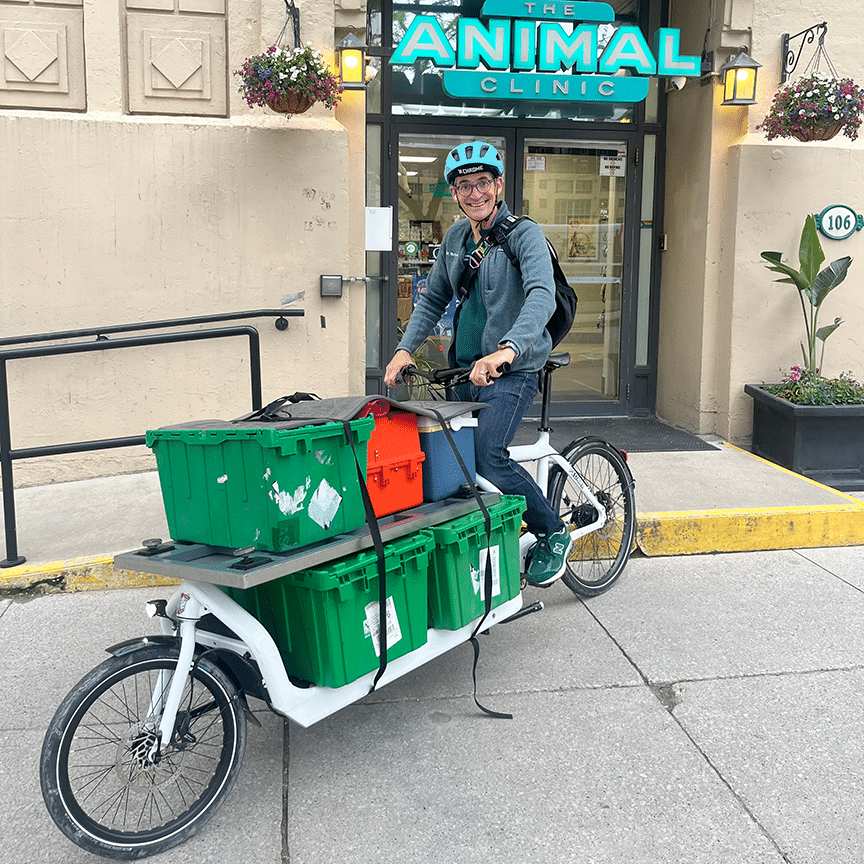
Some of the most rewarding outcomes came unexpectedly. Dr. Richardson, who commutes by bicycle year-round in Toronto, noticed a gradual shift among his staff.
“When I started commuting by bike, none of my staff biked to work,” he said. “Over time that has grown, and some days I have as many as five employees riding bikes to work.”
Staff involvement has also grown in other ways. Dr. Richardson’s head technician now seeks environmentally friendly purchasing options when feasible, sourcing biodegradable nitrile gloves and recyclable IV fluid bags when costs remain reasonable.
Operational changes at the clinic have largely involved small, practical adjustments rather than sweeping reforms. These include replacing paper towels with reusable rags for routine cleaning, turning off computers overnight and ensuring lights are shut off at closing time. Sustainability also factors into clinical discussions, including anesthetic protocols, food choices and parasiticide use.
Dr. Richardson has also reinforced sustainability through culture-building efforts. For the past three years, the clinic has provided staff with environmentally conscious, branded gifts such as personalized reusable mugs and embroidered fleeces — encouraging reusable habits while reducing energy use.
Over time, Dr. Richardson has noticed sustainability becoming embedded in the clinic’s identity. The team increasingly considers environmental impact in daily decisions, and sustainability is now discussed during hiring conversations.
“I’ve noticed that staff are caring more about being sustainable,” Dr. Richardson said. “It’s certainly becoming a part of our clinic culture.”
A greener future
Since becoming Green Paw certified, Dr. Richardson has seen measurable benefits both culturally and financially. Staff members have taken pride in working at a clinic recognized for sustainability leadership, further reinforcing engagement and morale. Financially, energy-saving upgrades — particularly the transition to LED lighting — have reduced operational costs.
While clients may not always recognize the sustainability efforts immediately, Dr. Richardson believes that is part of the success. Many of the changes were designed to maintain — or even enhance — client comfort while reducing environmental impact. For example, clients enjoy the clinic’s coffee service, though they may not realize it is shade-grown, bird-friendly, organic coffee sourced from a Toronto-based independent roaster. Similarly, lighting upgrades and energy-saving changes are largely invisible to visitors.
“Clients appreciate the good coffee we serve but may not be aware of the sustainability behind it,” Dr. Richardson said. “I think the important takeaway is that we can be more sustainable without sacrificing client comfort and quality medicine.”
Among the most impactful initiatives, Dr. Richardson pointed to energy efficiency improvements. Converting the entire clinic from fluorescent to LED lighting and installing smart thermostats reduced electricity use by 28% — an investment that paid for itself in approximately six months.
Looking ahead, Dr. Richardson plans to continue expanding sustainability efforts. Future goals include conducting a waste audit, calculating the clinic’s carbon footprint and replacing aging HVAC systems with heat pumps to further reduce energy consumption.
“I think those changes will have a significant impact on our electricity use in the future,” he said.
Dr. Duncan emphasized that sustainability efforts are most successful when they involve the entire veterinary team. While veterinarians play a key role, technicians, assistants and procurement staff routinely drive meaningful change by identifying alternative products or reducing reliance on high-impact materials. Engaging all team members, she said, creates both accountability and momentum.
That momentum is essential as the profession works toward more ambitious goals. While small steps may seem incremental, Dr. Duncan stressed they are necessary to build toward larger, systemic change — particularly as environmental challenges increasingly impact animal health. Issues like wildfire smoke, driven by climate conditions, are already affecting patients across species.
VSA’s Green Paw certification is designed as an entry point, with future tiers — Bronze, Silver and Gold — expected to introduce more rigorous standards, including formal greenhouse gas tracking. But achieving those higher levels will require widespread participation and alignment across the industry.
“We need a large community of people all rowing in the same direction before we can achieve those bigger, more complex goals,” Dr. Duncan said.
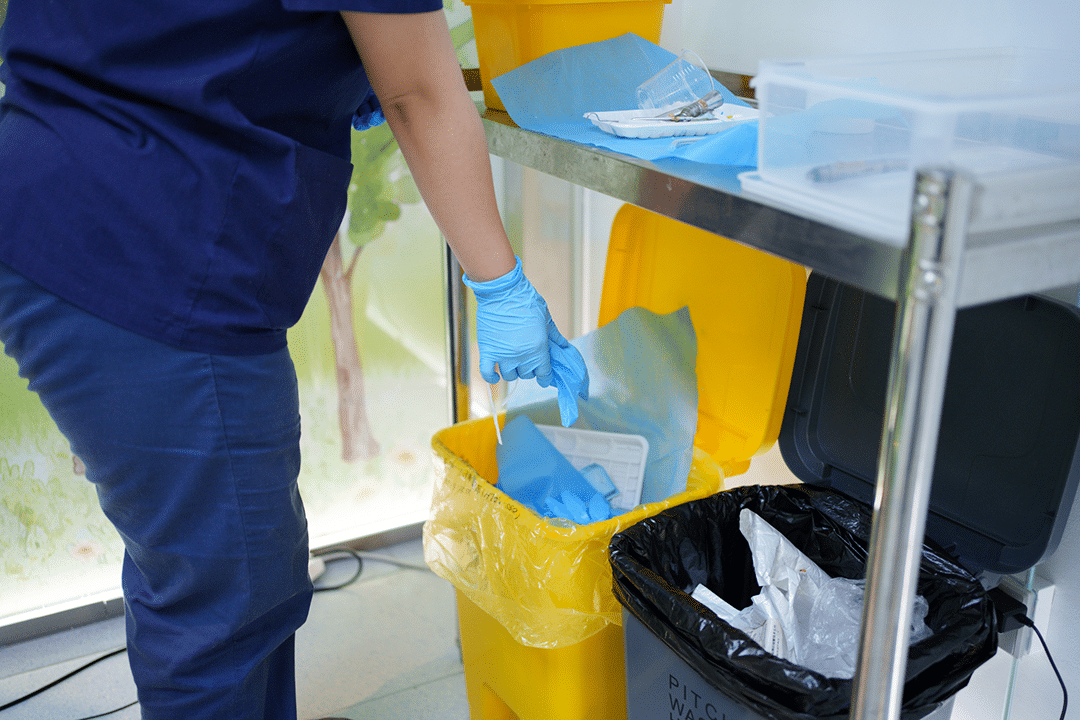
One of the most impactful early steps is conducting a waste audit. At CSU, Dr. Duncan and her colleagues found the exercise to be both practical and eye-opening. By reviewing what was being discarded, teams uncovered common misconceptions about recyclability and identified opportunities to divert waste more effectively. Just as important, the process sparked conversation and awareness across the clinic.
Photo Credits:
istockphoto.com/Nickbeer
istockphoto.com/Wengen Ling