


Using Artificial Intelligence for Disease Alerts
UC Davis researchers and partners used information on wildlife diseases to help identify and even predict outbreaks.
Artificial intelligence (AI) is beginning to break into animal health. One application that has already launched is WildAlert, an early warning system for wildlife health events.
The system gives health experts — including human, livestock and wildlife authorities — quick information on where wildlife disease events are occurring.
Many emerging infectious diseases originate in wildlife, including the Ebola virus, Nipah virus and SARS-CoV-2. These diseases have emphasized the need for surveillance in wildlife. Unusual illnesses or deaths in wildlife populations may serve as the first alert of an emerging health threat, according to Pranav Pandit, BVSc and AH, MPVM, PhD, assistant professor at UC Davis Weill School of Veterinary Medicine.
Developing the system
Until recently, implementation of targeted wildlife surveillance was costly and time-consuming for a wide range of threats across multiple species. This type of surveillance also can miss trends in the data due to its limited scope, according to a peer-reviewed article by Pandit and others.1
In California, wildlife rehabilitation centers are state-permitted nonprofits that rescue, treat and release sick or injured animals. Importantly, these centers also keep records of their patients. WildAlert saw the potential for the centers’ records to be streamlined, integrated and coded for AI learning.
“Most of these rehabilitation centers don’t have time and resources to put in diagnosis,” Pandit said. “However, they do write a lot of notes and observations. This was great for training a machine learning model that then tags these notes with clinical classifications that could present as proxy for disease.”
Training and learning
Obtaining the data started back in 2012, when the Wildlife Rehabilitation Medical Database (WRMD) was developed as a free, online database that allowed wildlife rehabilitation organizations to compile, analyze and standardize patient data by Wildlife Neighbors Database Project. This allowed organizations to enter real-time data about animal illnesses. Previously this information was unwieldy to connect between multiple reporting institutions.
With millions of records, the database also was a wealth of data to train an AI model, or machine learning algorithm. The team classified data into 12 clinical categories including neurological disease, respiratory disease, gastrointestinal disease and more. Then, they set thresholds to account for seasonality and trends.
Once the alert system was activated, the team conducted in-depth investigations of morbidity and mortality events involving a range of wildlife species, including diagnostic testing. These investigation helped validate the classifications and early results of the AI model.
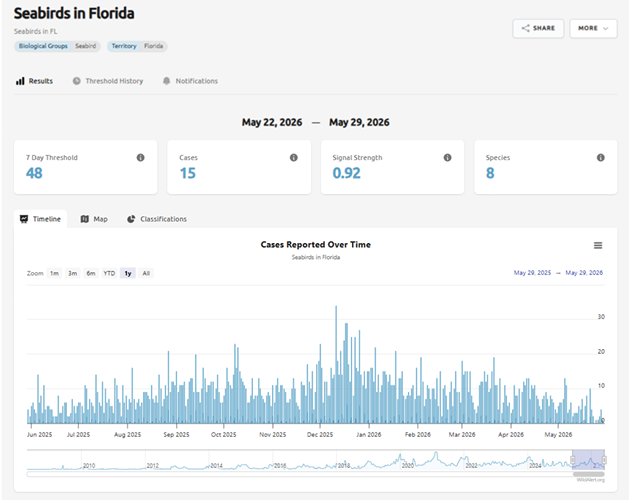
Today, WildAlert member organizations receive alerts when more than the expected number of cases are recorded across the rehabilitation network. Its scope is reaching across the country and five states use the alert system, including: California, Washington, Florida, Pennsylvania and Arizona.
“Our stakeholders are health officials and wildlife departments, which can track and follow specific species and receive notifications,” Pandit said. “It’s across all the wildlife species in those states, both mammals, birds and reptiles as well.”
For these organizations, AI applications like WildAlert offer the ability to do more important work with limited resources by automating data reporting and giving officials direction on where to investigate further.
Testing the application
Since development, the WildAlert system has detected several patterns of disease and toxicities in wildlife, including:
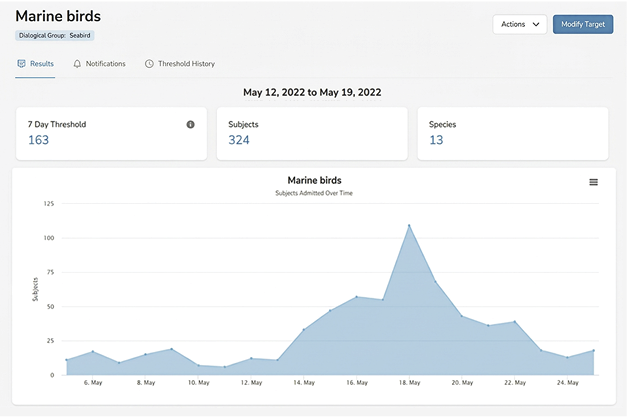
- Domoic acid intoxication in marine birds
- The northward spread of pigeon paramyxovirus type 1 (PPMV-1)
- West Nile Virus
- Parasitic diseases in birds
“We’ve identified some signals with response to HPAI (high pathogen avian influenza) in wild birds,” he said. “This work is not only additive to what the state agencies can do on their own, it’s multiplicative.”
Previously wildlife rehabilitation centers in California would submit an annual report with manually compiled data to the state health department. That reporting timeline was often too slow to get ahead of fast-spreading diseases, Pandit noted.
“Now, all they do is click a button, and the report goes to the state department,” Pandit explained. “WildAlert has become an additional tool for investigators, state veterinarians and game animal authorities.”
The application provides reports, which include visualization tools like maps down to the county level.
Supporting a One Health approach
WildAlert supports a One Health approach, Pandit noted. One Health is an integrated public health mindset that recognizes humans, domestic and wild animals are closely linked. While not new, One Health has become more important in recent years, according to the Centers for Disease Control.
“Many wildlife diseases are livestock concerns as well, like HPAI,” he said. “Our eventual goal is just one datastream.”
WildAlert can assist with early detection of, and alerting to, emerging diseases in wildlife that are also threats to domestic animal and human health. This can range from HPAI to WNV to harmful algal blooms. Beyond wildlife diseases, he said AI has interesting applications for the health and well-being of all animals.
“There are researchers at UC Davis working on predictive models for livestock outbreaks and to better understand the impact on climate change. The machine learning model is a wonderful application and opens up new avenues,” Pandit said. “Still, the role of veterinarians is crucial. For example, our AI model is trained well but that training depends on how good the data is. Working with subject-matter experts — like clinical faculty or veterinarians — is super important so the models are unbiased and trustworthy.”
WildAlert also is in partnership with a network of wildlife rehabilitation organizations in California, Florida, Pennsylvania, Arizona and Washington.
Traditional wildlife health surveillance relies on definitive diagnoses. WildAlert helps identify patterns before diseases are formally confirmed.
Photo Credits:
istockphoto.com/Mr Vito
Charts courtesy of UC Davis Weill School of Veterinary Medicine